
Product Overview
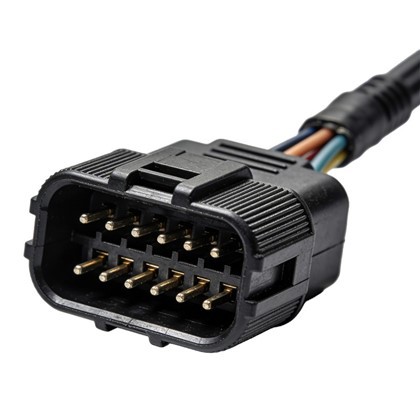
Precision-engineered interconnection systems for automotive electrical and electronic architectures. Built for low-voltage signal transmission and high-voltage power distribution in passenger cars, commercial vehicles, and electric vehicle (EV) powertrains.
Constructed from engineering thermoplastics paired with copper alloy contacts featuring selective plating. Conforms to USCAR-2 and LV214 test standards for vibration, thermal cycling, and electrical stability.
-

Automotive Socket Connectors
An Automotive Socket Connector is a female connector for vehicle electrical systems. This socket connector has a 14-pin configuration with a 2.5mm pitch spacing. The connector has a 5A current... Add to Inquiry -
Automotive Plug Connectors
An Automotive Plug Connector is a male connector for vehicle electrical systems. This plug connector has a 14-pin configuration with a 2.5mm pitch spacing. The connector has a 5A current rating... Add to Inquiry -
Sealed Automotive Connectors
A Sealed Automotive Connector is designed for waterproof connections in harsh environments. This sealed connector has a 8-pin configuration with a 3.0mm pitch spacing. The connector has a 6A... Add to Inquiry -
Automotive Wire To Wire Connectors
An Automotive Wire to Wire Connector is designed for reliable in-line wire connections. This wire to wire connector has a 6-pin configuration with a 4.0mm pitch spacing. The connector has a 10A... Add to Inquiry -
Automotive Wire To Board Connectors
An Automotive Wire to Board Connector is a versatile connection solution for wire-to-board applications. This connector has a 10-pin configuration with a 2.5mm pitch spacing. The connector has a... Add to Inquiry -
Automotive PCB Connectors
An Automotive PCB Connector is a board-mount component for automotive electronic assemblies. This PCB connector has a 8-pin configuration with a 2.5mm pitch spacing. The connector has a 4A current... Add to Inquiry -
Automotive Sensor Connectors
An Automotive Sensor Connector is a specialized component for vehicle sensor systems. This sensor connector has a 3-pin configuration with a 2.0mm pitch spacing. The connector has a 3A current... Add to Inquiry -
Car Battery Terminal Connectors
A Car Battery Terminal Connector is a critical component for secure battery connections. This battery terminal connector has an M8 stud size with a 10mm cable entry. The connector has a 100A... Add to Inquiry -
Automotive Wiring Harness Connectors
An Automotive Wiring Harness Connector is an essential component for wiring harness assembly. This connector has a 16-pin configuration with a 2.8mm pitch spacing. The connector has a 7A current... Add to Inquiry -
Automotive Electrical Connectors
An Automotive Electrical Connector is a critical component for vehicle electrical systems. This connector has a 12-pin configuration with a 2.5mm pitch spacing. The connector has a 5A current... Add to Inquiry -
Car Headlight Bulb Connector
We have operated our factory since 2014, focusing on precision molds. We serve major brands both domestically and internationally. Our in-house mold team uses high-end machines, which is why our... Add to Inquiry -
Car Light Connectors
We take mold making seriously and use high-precision CNC machines. As a result, our car light connectors maintain a tight tolerance of ±0.01 mm. This ensures a 1:1 match with the original lamp... Add to Inquiry



Key Features
Primary & Secondary Lock (TPA)
Integrated Terminal Position Assurance mechanisms eliminate incomplete insertion and prevent terminal back-out under severe vibration.
Polarization & Keying
Multi-directional physical polarization ribs prevent mis-mating on assembly lines, eliminating short-circuit risks.
Shielding Options
Metal shell variants provide 360-degree EMI/RFI shielding for sensitive sensor lines and high-voltage inverter connections.
Compact Footprint
High-density terminal spacing (0.5mm to 2.8mm pitch options) engineered for space-constrained engine bays and dashboard ECUs.
Technical Specifications
|
Parameter |
Specification |
Standard / Test Method |
|
Operating Voltage |
Up to 1000V DC (High Voltage) / 48V DC (Low Voltage) |
IEC 60664-1 |
|
Current Rating |
2.0A to 40.0A per contact (terminal size and wire gauge dependent) |
USCAR-2 |
|
Operating Temperature |
-40°C to +125°C (PA66/PBT) / -40°C to +150°C (High-Temp PA6T/SPS) |
ISO 16750-4 |
|
Contact Resistance |
Initial: = 100 MΩ at 500V DC |
EIA-364-21 |
|
Dielectric Withstanding Voltage |
1000V AC to 3000V AC (1 minute) |
MIL-STD-202 Method 301 |
|
Ingress Protection |
IP67, IP69K (Mated condition) |
IEC 60529 / DIN 40050-9 |
|
Durability (Mating Cycles) |
10 to 50 cycles (Plating dependent) |
USCAR-2 |
|
Vibration & Mechanical Shock |
24 Hz to 2000 Hz random vibration; 50g shock pulse |
USCAR-2 / ISO 16750-3 |
Materials & Manufacturing Processes
Material Selection
Housing: Polybutylene Terephthalate (PBT-GF30) and Polyamide (PA66-GF25, PA6T) reinforced with glass fiber for dimensional stability, creep resistance, and UL94 V-0 flame retardancy.
Terminals: High-conductivity Copper Alloys (C7025, Phosphor Bronze, Brass) selected for spring force retention and current capacity.
Plating: Tin (Sn) plating for low-vibration signal lines; Gold (Au) or Silver (Ag) selective plating on contact interfaces to prevent fretting corrosion.
Seals: High-consistency silicone rubber (HCR) and Fluorosilicone (FVMQ) for chemical resistance against automotive fluids.
Manufacturing Processes
Precision Tooling & Molding: Mold inserts machined from tool steels (S136, NAK80) via high-speed CNC and wire EDM, maintaining core tolerances within +/- 0.01 mm. Processed on multi-cavity electric injection molding machines (Fanuc, Arburg) with closed-loop cavity pressure control to maintain housing dimensions within +/- 0.02 mm.
High-Speed Stamping: Progressive stamping dies operating at up to 1000 strokes/min on Bruderer presses to form consistent terminal geometry without burrs.
Selective Electroplating: Automated reel-to-reel electroplating lines applying precise micron-level gold/tin deposits strictly on contact mating areas.
Automated Assembly & Inspection: In-line optical inspection (AOI) systems verify terminal seating depth, seal presence, and lock integrity prior to packaging.

Applications
EV Powertrains
High-voltage connection systems for traction inverters, on-board chargers (OBC), and DC-DC converters.
01
Battery Management Systems (BMS)
Modular wire-to-board and wire-to-wire harnesses monitoring cell voltage and temperature across battery packs.
02
Advanced Driver Assistance Systems (ADAS)
Shielded high-speed data transmission connectors for radar, LiDAR, and camera modules.
03
Under-Hood Compartments
Sensor connections for camshaft position, exhaust gas recirculation (EGR), and fuel injection systems.
04
Commercial & Off-Highway Vehicles
Heavy-duty sealed bulkhead connectors for agricultural machinery, construction equipment, and truck chassis wiring.
05
Customization & OEM/ODM Solutions
Tooling Development
In-house mold design and tool-making facility utilizing high-speed CNC machining, wire EDM, and optical profile grinders for custom cavity blocks.
Pin Configurations
Proprietary housing layouts, non-standard keying codes, and hybrid configurations combining signal and power circuits in a single shell.
Wire Harness Integration
Collaborative pre-crimped cable assembly options matching automotive wire standards (SAE J1128, ISO 6722).
Prototyping Pipeline
3D-printed functional prototypes (SLA/SLS) delivered within 7 business days, followed by steel mold fabrication and PPAP sample submission.
Quality Control
Quality Management System
Certified to IATF 16949:2016 and ISO 9001 standards.
Insertion/Extraction Force Testing
Automated force-displacement test stands (Instron systems) to verify mating ergonomics.
Thermal Shock Chambers
Testing thermal transition from -40°C to +140°C per LV214.
Salt Spray Testing
96 to 500-hour neutral salt spray chambers (ASTM B117) to evaluate plating corrosion resistance.
X-Ray Fluorescence (XRF) Spectrometry
Coating thickness and elemental material composition verification.
PPAP Documentation
Level 1 through Level 5 PPAP packages (Dimensional results, Material test reports, FMEA, Process Flow Diagrams, CPK studies) provided upon request.
Frequently Asked Questions

Request a Quote
Ready to discuss technical requirements or request drawings, samples, and PPAP documentation?
Submit Inquiry: Contact our engineering sales team via modeloncn.com.
Required Information for Fast Quotation: Part number or equivalent cross-reference, annual volume forecast, target operating environment (temperature, voltage, current), and required compliance documents (IMDS, PPAP Level).
With abundant experience, we are one of the most professional automotive connector manufacturers and suppliers in China. Welcome to buy customized automotive connector at competitive price from our factory. If you have any enquiry about pricelist, please feel free to email us.
Automotive Weatherproof Connectors, Car Headlight Bulb Connector, High Voltage Connectors Automotive