
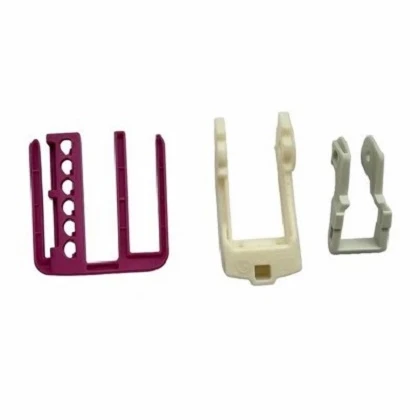
Precision Injection Molded Components For Medical Devices
Overview
Custom injection molded plastic components engineered for diagnostic, surgical, and drug delivery systems. Manufactured under strict ISO 13485 quality frameworks, our production focuses on tight dimensional stability, biocompatible material selection, and cleanroom assembly readiness. We partner with medical device OEMs from prototype tooling to high-volume validation, ensuring seamless scale-up and compliance with FDA regulatory standards.
Specifications
|
Parameter |
Standard Capability |
Precision Capability |
|
Dimensional Tolerance |
+/- 0.05 mm |
Up to +/- 0.01 mm (critical features) |
|
Clamp Tonnage |
50T to 350T |
Electric & hybrid servo-driven presses |
|
Shot Weight |
0.1 g to 500 g |
Micro-molding and thin-wall capabilities |
|
Cleanroom Class |
ISO Class 8 (Class 100,000) |
ISO Class 7 (Class 10,000) environment available |
|
Sterilization Compatibility |
EtO, Gamma Irradiation, E-Beam, Autoclave (121 deg C / 134 deg C) |
Features
Tight Tolerance Replication: Servo-electric injection units deliver closed-loop cavity pressure control for stable part dimensions across multi-cavity tools.
Traceability Integration: Laser-etched data matrices or cavity-number identification molded directly into components for full lot-to-resin batch traceability.
Cleanroom Post-Processing: Automated part removal, gate trimming, and inner-packaging executed directly inside controlled environments to eliminate particulate contamination.
Validation Readiness: Comprehensive IQ/OQ/PQ documentation packages supported by automated vision inspection data and CMM reports.
Materials & Manufacturing
Medical-Grade Resins Processed
Amorphous Polymers: PC (Polycarbonate), PSU (Polysulfone), PES, COP/COC (Cyclic Olefin Polymer/Copolymer for optical clarity and low birefringence).
Semi-Crystalline Polymers: PP (Polypropylene), HDPE/LDPE, PEEK, POM (Delrin), PA (Nylon).
Elastomers: TPE, TPU, LSR (Liquid Silicone Rubber) for soft-touch seals and diaphragms.
Manufacturing Infrastructure
Tooling Construction: In-house precision tool room equipped with high-speed CNC, wire EDM, and mirror EDM to maintain mold life exceeding 1,000,000 cycles.
Molding Machines: Fanuc and Arburg electric injection presses featuring dry-air resin drying systems and closed-loop water temperature controllers to prevent thermal degradation.
Applications
Diagnostic Consumables: Microfluidic chips, reagent cartridges, and sample collection vials requiring optical clarity and zero extractables.
Surgical Instruments: Ergonomic reusable and disposable device housings, trocars, and endoscope components.
Fluid Management: Manifolds, connector valves, luer fittings, and drip chambers requiring leak-free sealing under pressure.
Drug Delivery Devices: Pen injector bodies, inhaler internal actuators, and auto-injector structural shells.
Customization
Tooling Options: Prototype aluminum molds (quick-turn, 1 to 5 cavities) and production-grade hardened steel molds (multi-cavity with hot runner systems).
Secondary Operations: Ultrasonic welding, pad printing, laser marking, and sub-assembly integration.
Packaging Solutions: Cleanroom double-bagging, custom thermoformed tray packaging, and custom labeling per customer specifications.
QC & Quality Assurance
Inspection Equipment: Keyence optical comparators, 3D CMM, automated multi-axis vision measuring systems, and laser roughness testers.
Process Control: Real-time cavity pressure monitoring and automated reject sorting for out-of-spec shots.
Certifications: ISO 13485:2016 certified facility; cleanroom environment verified regularly via particle counters and microbial monitoring.
Documentation: Material Test Reports (MTR), Certificate of Analysis (CoA), and full dimensional inspection reports supplied with every production lot.
FAQ
Q: What is your standard lead time for medical mold tooling and initial samples?
A: Tooling fabrication typically takes 4 to 6 weeks depending on part complexity. T1 samples and initial dimensional reports are delivered within 7 business days following mold completion.
Q: Do you provide full IQ/OQ/PQ validation support?
A: Yes. We supply complete validation protocol templates and execution data, including Installation Qualification (IQ), Operational Qualification (OQ), and Performance Qualification (PQ) support for regulated devices.
Q: How do you handle medical-grade resin storage and lot control?
A: All medical resins are stored in a temperature- and humidity-controlled warehouse. Material lot numbers are recorded at the resin hopper and tracked through packaging labels to ensure strict FIFO and traceability.
Q: Can you accommodate multi-material or insert molding?
A: Yes. We utilize multi-shot injection presses and vertical rotary tables for plastic-to-metal inserts and dual-hardness (rigid body + soft seal TPE) configurations.
RFQ
To provide an accurate technical and commercial evaluation, please submit your project requirements to our engineering team at [Insert Email / RFQ Portal Link].
Required Information Checklist
CAD Files: 3D models (STEP, IGES, or Parasolid) and 2D technical drawings with critical tolerance callouts.
Material Specification: Specified resin grade or functional requirements (e.g., sterilization method, optical clarity, chemical resistance).
Volume Projections: Estimated annual volume (EAU), batch sizes, and target launch schedule.
Regulatory Requirements: Cleanroom packaging needs, FDA submission stage, and required quality documentation (IQ/OQ/PQ, CoA).
Hot Tags: precision injection molded components for medical devices, China precision injection molded components for medical devices manufacturers, suppliers, factory
Send Inquiry
