
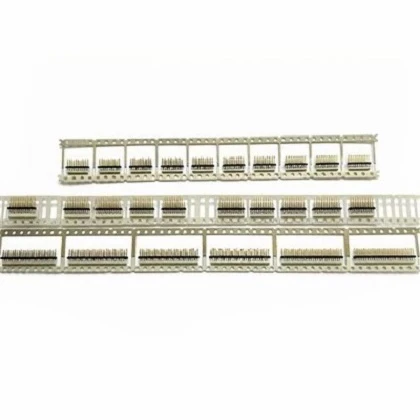
Precision Injection Molded Parts For Small Electronic Devices
Overview
Compact electronic devices demand tight spatial constraints, strict wall-thickness uniformity, and zero tolerance for cosmetic or structural defects. This manufacturing solution provides custom high-precision injection-molded parts engineered for small electronic enclosures, internal brackets, structural frames, and micro-connectors.
Production focuses on micro-molding and multi-cavity hot runner systems capable of maintaining stable tolerances for parts weighing less than 5 g. Operations combine electric injection molding presses, in-house high-speed CNC tooling, and optical profile inspection to deliver production-ready components that meet electronic assembly requirements.
Specifications
|
Parameter |
Technical Standard / Range |
|
Dimensional Tolerance |
Up to +/-0.01 mm (depending on geometry and material) |
|
Minimum Wall Thickness |
0.25 mm - 0.40 mm |
|
Shot Weight Capacity |
0.05 g - 50 g |
|
Clamping Force |
15 Tons - 150 Tons (Electric & Hybrid Presses) |
|
Mold Cavitation |
1+1 up to 32+32 cavity systems |
|
Surface Finish |
SPI A1-D3, VDI 3400 texture, or custom bead blast |
|
File Formats Accepted |
STEP, IGES, Parasolid, DXF, DWG (with 2D GD&T drawings) |
Features
Micro-Feature Fidelity: Optimized runner balancing and precise cavity venting eliminate short shots and sink marks in thin-walled sections (< 0.5 mm).
Zero-Flash Gate Control: Subsurface, tunnel, and thermal gate options minimize gate vestige on visible external surfaces, eliminating secondary trimming.
Low-Warpage Management: Mold cooling conformal channels and cavity temperature controllers prevent dimensional distortion in glass-filled engineering plastics.
Cleanroom Production: Class 100,000 (ISO Class 8) cleanroom environment available for molding optical lenses, clear covers, and medical wearable enclosures.
Materials & Manufacturing
Common Engineering Resins
PC / ABS: High impact resistance, dimensional stability; ideal for handheld device housings.
LCP (Liquid Crystal Polymer): High flowability, ultra-thin wall capability, high heat resistance; suited for micro-connectors.
POM (Delrin): Low friction, high stiffness, excellent dimensional repeatability for internal gears and sliding tracks.
PEEK / PPS: High temperature endurance, chemical resistance, structural rigidity for demanding industrial electronics.
TPU / TPE: Overmolding and dual-shot capabilities for soft-touch grips, waterproof seals, and impact bumpers.
Tooling Steel & Manufacturing Equipment
Mold Steel Selection: Premium pre-hardened and hardened mold steels (e.g., S136, NAK80, DIN 1.2344) selected based on resin abrasiveness and high-gloss or high-polish requirements.
Injection Presses: Fanuc and Sodick electric injection molding machines (15T to 150T) featuring closed-loop pressure feedback control.
Tooling Infrastructure: In-house tool room equipped with Makino high-speed CNC milling (+/-0.002 mm), Sodick wire EDM, and mirror-finish EDM sinkers.
Applications
Consumer Audio: True Wireless Stereo (TWS) earbud acoustic chambers, charging case internal frames, and button actuators.
Wearable Technology: Smartwatch structural mid-frames, sensor bezels, and back covers requiring moisture sealing.
Miniature IoT Devices: Compact gateway enclosures, sensor housings, and snap-fit battery compartments.
Medical Electronics: Handheld diagnostic device housings and disposable diagnostic cartridge components.
Customization
Customization starts from DFM (Design for Manufacturing) analysis to optimize draft angles, eliminate sharp internal corners, and balance wall thicknesses.
Insert Molding: Overmolding stamped metal pins, threaded brass inserts, and flexible circuits directly into the plastic matrix.
Two-Shot (Bi-Injection): Combining rigid substrates (PC/ABS) with soft elastomer grips (TPU) in a single cycle.
Post-Processing: Laser etching for icons/serial numbers, ultrasonic welding for hermetic enclosures, and EMI shielding coating (conductive paint or vacuum sputtering).
Quality Control & Certifications
Quality Management Systems: Certified to ISO 9001 and ISO 13485 (Medical Devices) standards, ensuring rigorous process control and component consistency.
Dimensional Inspection: Keyence IM-7000 optical image dimension analyzer and Hexagon CMM for first-article inspection (FAI) and full dimensional reports.
Process Monitoring: Decoupled molding parameters monitored in real-time; cavity pressure sensors track viscosity shifts per shot.
Functional Testing: Insertion force testing, drop impact testing, and IP waterproof leak testing (air decay method) executed per lot requirements.
Traceability: Raw material lot certificates (CoA), RoHS/REACH compliance documentation, and complete production traveler records maintained for 3 years.
FAQ
Q: What is your typical tooling lead time for a small electronic housing mold?
A: Standard tooling lead times range from 15 to 25 business days, depending on part complexity, core/cavity machining difficulty, and texturing requirements. T1 samples are delivered alongside full CMM inspection reports.
Q: How do you handle thin-wall warping for engineering thermoplastics like LCP or PC?
A: DFM analysis is performed prior to steel cutting to identify high-stress areas. We utilize conformal cooling channels, balanced gate positioning, and precise melt-temperature control to minimize internal residual stress and prevent post-molding warpage.
Q: What is your minimum order quantity (MOQ) for production runs?
A: Tooling orders can start with prototype runs (from 100 pieces). Volume production MOQs typically start at 1,000 to 5,000 pieces per batch, optimized against machine setup and material lot sizing.
Q: Can you sign an NDA before we share CAD drawings?
A: Yes. We execute Mutual Non-Disclosure Agreements (MNDA) immediately upon request to protect your proprietary IP, drawings, and functional specifications.
RFQ
To receive a formal quotation within 24 hours, please provide the following technical inputs via email:
CAD Data: 3D model (STEP/IGES) and 2D drawing with critical tolerances (GD&T).
Material Specifications: Grade designation or target mechanical/thermal performance requirements.
Estimated Annual Volume (EAV): Projected batch sizes and annual demand.
Surface Finish & Post-Processing: SPI/VDI finish requirements, secondary operations (pad printing, EMI coating, ultrasonic welding).
Target Delivery Timeline: Tooling schedule and initial sample requirement date.
Hot Tags: precision injection molded parts for small electronic devices, China precision injection molded parts for small electronic devices manufacturers, suppliers, factory
Send Inquiry
